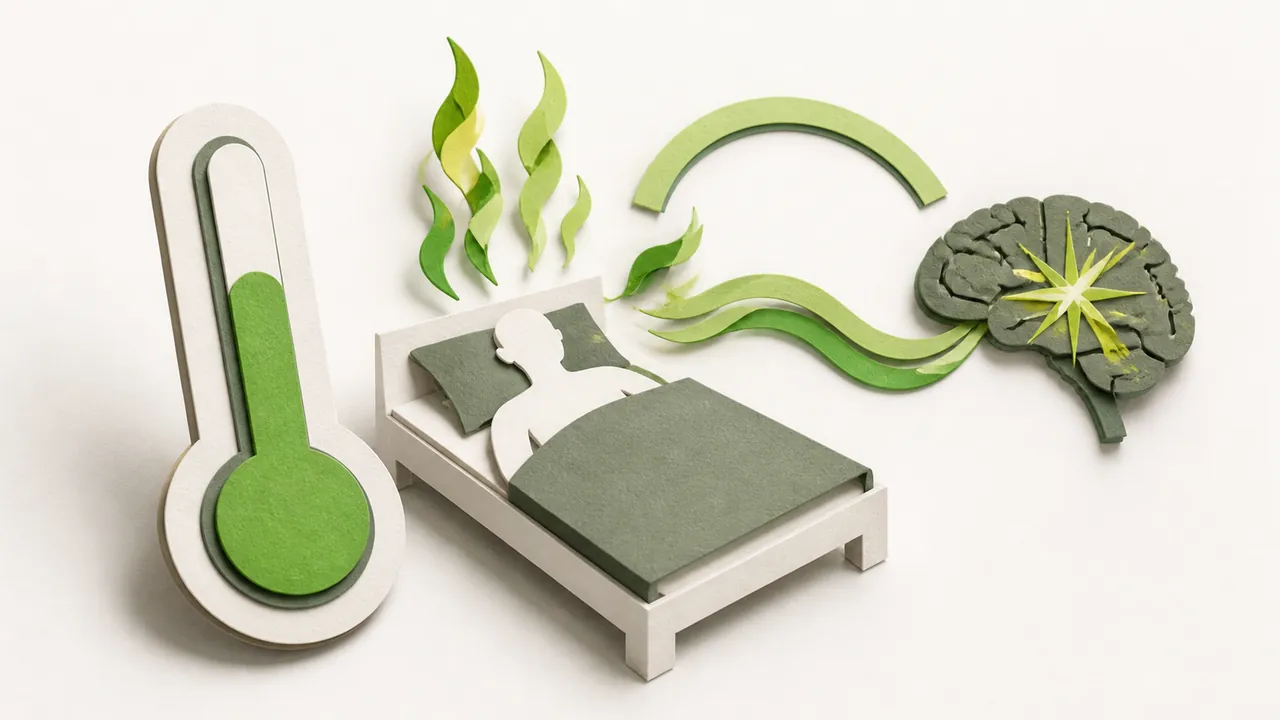
A bedroom at twenty-eight degrees costs you an hour of deep sleep per night — that's a measure from the National Institute of Sleep and Vigilance. You don't need air conditioning to fix that. This guide gives you five validated techniques that lower room temperature by three to four degrees, at no ongoing cost and with no noise. We start with the thermal physics of your bedroom, and finish with what to do with your body in the hour before sleep.
01 / 04Why 28°C wrecks your sleep the INSV science in 2 points
To act effectively, you first need to understand why heat wrecks sleep.
Above 19°C: your brain stays on guard
Your brain triggers deep sleep when your core body temperature drops by half a degree. This natural cooling normally happens between nine PM and midnight — but it's blocked if the room stays above nineteen degrees, because the warm environment prevents your body from losing heat through the skin. Result: you stay in light sleep, wake up frequently, and get up tired even after eight hours. Good news: you don't need to reach seventeen degrees — nineteen to twenty-one degrees is enough for the mechanism to work.
Synthetic sheets = heat trap
Before we get to active techniques, a note on bedding. Synthetic sheets — polyester, microfibre — trap body heat and sweat moisture. They can raise local skin temperature by two to three degrees compared to a cotton sheet. The cheapest fix: a flat cotton or linen sheet. Linen is the best choice — it absorbs up to twenty percent of its weight in moisture and releases it through evaporation, cooling the fabric surface. A one-time investment that transforms summer nights.
02 / 04Shutters — thermal management block the sun before it gets in
Technique number one: shutter management. It has the biggest thermal impact — and it's the most overlooked move.
Close sun-side shutters by 10 AM
The main source of heat gain in a bedroom in summer is windows exposed to sunlight. Standard glazing lets through up to eighty percent of solar radiation. The thermal rule is simple: blocking the radiation before it enters the glass is far more effective than blocking it inside. So closed shutters — ideally with adjustable slats — massively outperform interior blackout curtains. Critical timing: close before ten AM on east and south-facing windows, before two PM on west-facing ones. Miss a single window on a heatwave day and you can add two to three degrees to the entire room. Build this as an automatic habit, like locking the door.
Open at night — only after 10 PM
The most common mistake: opening windows at eight PM because it's still twenty-five degrees outside. Result: you let warm air into a room that's already cooler. The thermal rule: open your windows only when the outside air is cooler than the inside — usually after ten PM in summer. Simple test: hold your hand at the window for five seconds. If the outside air feels cooler than the air around your hand, open up. Leave the window open until seven or eight AM, then close everything before the sun starts heating the walls.
03 / 04The air — smart fan tricks DIY AC at zero cost
Technique number two: turn your fan into a real cooler. Two variants depending on the time of day.
Fan + frozen bottle — DIY AC
A fan alone doesn't cool the air — it accelerates evaporation on your skin, which makes you feel two to three degrees cooler. To go further, turn it into a DIY air conditioner: place one or two frozen one-litre water bottles — or a tray of ice — directly in front of the fan's intake grille. The air passes over the cold surface, cools through convection, and exits two to three degrees colder on the other side. Autonomy: the bottles last between one and a half and two and a half hours depending on ambient heat. Zero extra cost if you already have a freezer.
Wet sheet at the window — nights only
Second airflow technique for the night: a wet sheet at the window. Take a cotton sheet, dampen it under cold water — not soaking, just moist — and hang it in front of the open window. The warm air coming in passes through the damp fabric, loses energy through evaporation, and arrives in the room cooler. Maximum effectiveness when outside humidity is below fifty percent. In Mediterranean regions or on dry, windy days, this technique can drop the temperature of incoming air by three to five degrees.
04 / 04Your body — cool from within socks, wrists, lukewarm shower
Technique number three: act directly on your body's thermoregulation. Two moves with an immediate effect.
Frozen socks + cold wrists and ankles
Cooling the room isn't enough if your body stays at a high temperature. Two moves that work immediately. First: run your wrists and the inside of your ankles under cold water for thirty seconds. These areas have shallow veins close to the skin surface — cooling the circulating blood there is fast and spreads through the body within minutes. Second: put your lightweight cotton socks in the freezer twenty minutes before bedtime. Cold feet trigger skin vasodilation that promotes body cooling — a mechanism identified by sleep research as one of the key triggers for deep sleep onset.
Lukewarm shower (not cold) — the mistake everyone makes
The common mistake: a cold shower before sleep. It seems logical but produces the opposite effect. Cold triggers vasoconstriction, the body retains its internal heat to warm back up, and your temperature rises again within fifteen minutes. The right approach: a lukewarm shower — between thirty and thirty-four degrees. Lukewarm water opens the skin's capillaries, body heat escapes through the skin, and your core temperature drops naturally. Last point: drink two glasses of cool water in the hour before sleep. Dehydration raises body temperature and fragments sleep. Not ice-cold — the stomach expends energy warming it up, which counteracts the effect.
This advice is general information and does not replace a professional's opinion. When in doubt (health, electricity, chemicals), ask a specialist.
Sources
Want more tips like this one?
Subscribe to the channel