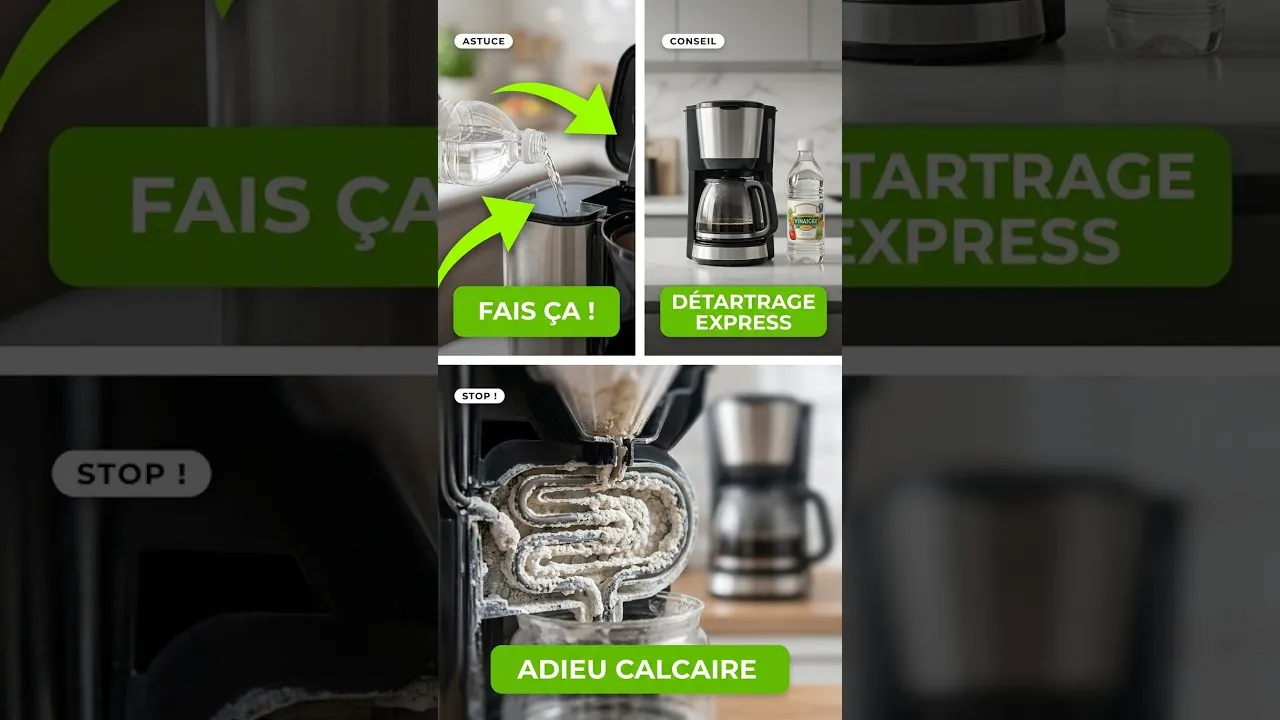
Is your coffee maker taking three times longer to brew? Does the coffee taste bitter, slightly metallic? It's not the machine aging badly — it's limescale building up on the heating element. And the good news is that all you need is white vinegar — which you probably already have in your cupboard — to reset everything in ten minutes.
01 / 04Why descale what limescale actually does
Before the method, understand what limescale is actually doing to your machine.
Limescale = clogged heating element
Tap water contains minerals — mainly calcium and magnesium. With every cycle, when the water is heated, some of those minerals precipitate and form a white deposit on the heating element. Over weeks, this deposit thickens. The element then needs to heat longer to reach the target temperature — which explains the slower cycles. It uses more electricity. And in severe cases, it ends up overheating and breaking down. According to manufacturers, a 1.5mm limescale deposit increases the heating element's power consumption by around 10%. Over 3 years of daily use, that's roughly one whole coffee maker's worth of wasted electricity.
Altered taste + bacteria
Second problem: taste. Limescale alters the water temperature at the point of brewing — if the water doesn't reach the ideal 90-95 degrees, it extracts the coffee's aromas poorly. Result: a bitter or flat cup. And a third problem often overlooked: thick limescale creates zones of stagnant water in the circuit — a breeding ground for bacteria and mould. That's why manufacturers recommend descaling every two to three months, even if you can't see anything from the outside.
02 / 04What you need vinegar + water, that's it
Good news: no need to buy a descaling product. Two ingredients are all you need.
1/3 white vinegar + 2/3 water
The effective ratio is simple: one third distilled white vinegar to two thirds cold water. No need for wine vinegar or apple cider vinegar — only white vinegar at five or six percent acidity, the kind that costs one euro at any supermarket. For a standard one to one-and-a-half litre coffee maker: about five hundred millilitres of vinegar and one litre of water. You don't need to go beyond this ratio — undiluted vinegar is no more effective against limescale but increases the risk of damaging internal seals on some models.
No undiluted vinegar — seal risk
One last point on preparation: avoid using undiluted pure vinegar, even if some forums recommend it. Concentrated acetic acid can attack the rubber seals inside the coffee maker — particularly the valve and water tube seals. At five or six percent diluted to one third, you have more than enough acidity to dissolve limescale without risking the seals. If the vinegar smell bothers you, you can replace half the vinegar with fresh lemon juice — citric acid is just as effective and much less pungent.
03 / 04The procedure cycle + rinse × 2
Now the method: one descaling cycle, then two plain water rinse cycles.
Fill, run the full cycle
Pour the mixture into the reservoir as you would with plain water. Remove the coffee filter — there should be no paper filter or ground coffee in the machine. Run a full cycle. Let the acidic water flow through the entire circuit: the feed tube, the heating element, the shower head, and into the carafe. Some models have a dedicated 'descale' program — if yours has one, use it. It adjusts the temperature and flow speed for optimal action. If your machine doesn't have this program, a standard coffee cycle works perfectly.
Rinse × 2 with plain water
Once the descaling cycle is done, empty the carafe and rinse it. Then fill the reservoir with plain cold water — no vinegar — and run a full cycle. Empty again. And repeat: second plain water cycle. Two rinse cycles are needed to completely flush out the acetic acid residue from the circuit. If you only rinse once, your first coffee after descaling will have a faint vinegar aftertaste — not harmful, but unpleasant. Some people who are sensitive to the smell even prefer three rinse cycles: that's a valid option.
04 / 04Frequency & care every 2-3 months, depending on water
To finish: how often you should do this, and how to prevent limescale from building up too fast.
Hard water → every 2 months
The frequency depends on the water hardness in your area. In France, hardness is measured in French degrees — water is considered 'hard' above 25 degrees. In hard-water zones — Paris, Lyon, eastern France — limescale builds up twice as fast. Descaling every two months is recommended. In soft-water zones — Brittany, the Basque Country, mountain regions — every three to four months is enough. If your coffee maker has a built-in limescale indicator, trust it. Otherwise, the most reliable signal is the brewing slowdown: if your machine takes 25% longer than when it was new, it's time to descale.
Filtered water → less limescale
If you want to reduce descaling frequency, use filtered water — a Brita-style filter jug reduces water hardness by around 70%. You'd go from descaling every two months to every five or six months. Some high-end coffee makers — Delonghi, Miele — also offer optional built-in water filters. If you use bottled water, avoid highly mineralised ones like Hépar or Contrex — they actually contain more calcium than tap water in some cities. Evian or Volvic are better options if you really want to minimise limescale.
This advice is general information and does not replace a professional's opinion. When in doubt (health, electricity, chemicals), ask a specialist.
Sources
Want more tips like this one?
Subscribe to the channel