How long does it take you to clean a room? An hour? Two? Professional cleaners do it in fifteen minutes — not because they do less, but because they follow a precise order. And we're going to give you that order right now.
01 / 04Why this order physics does the work
Before you start, understand why this order isn't random — it's physics.
Always top → bottom
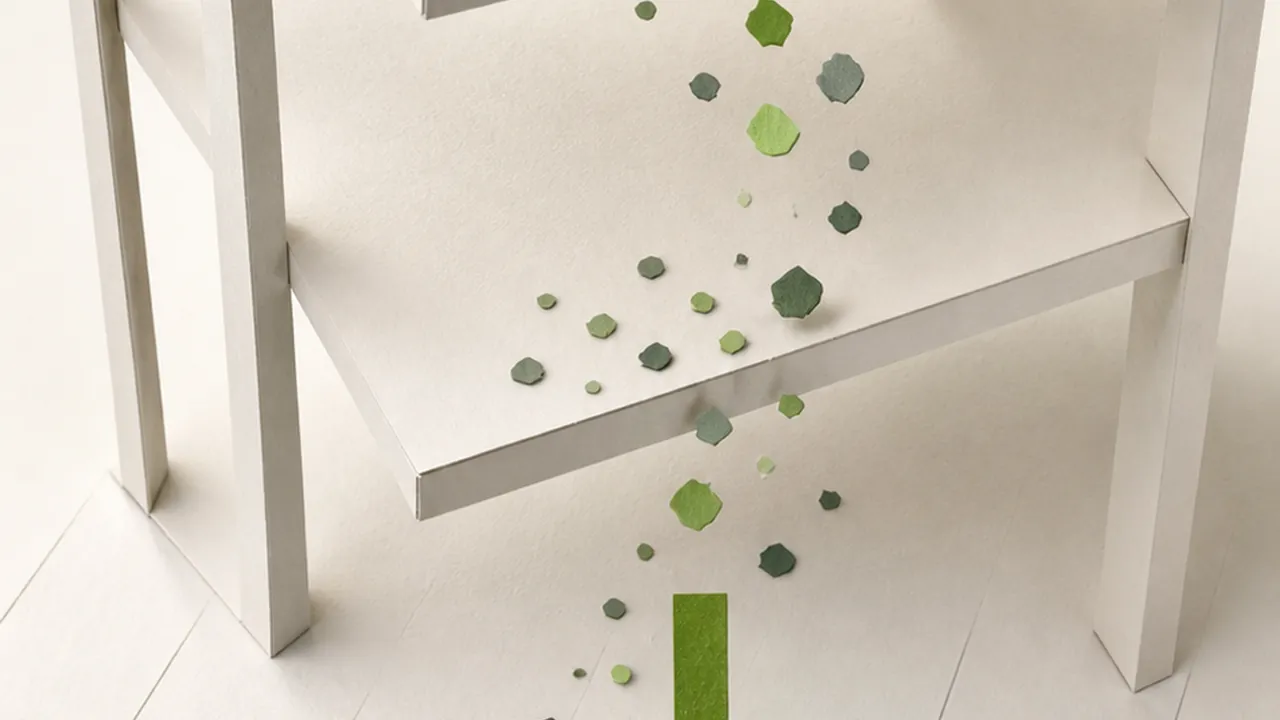
The number-one rule of professional cleaning is simple: always start at the top and finish with the floor. Why? Because when you dust a shelf, the dust that flies up falls back down. If you've already vacuumed before, you'll have to do it again. Professional cleaners never do the same job twice — they follow gravity. Shelves, frames, tops of furniture first. Floor last.
15 min = 4 timed zones
Fifteen minutes sounds short. But professionals split the room into four timed zones: two minutes to clear the clutter, four minutes to dust the high surfaces, four minutes for the hand-height surfaces, and five minutes for the floor. These durations aren't random — they match the real time each zone takes in a standard room. The key is to stick to the order and never mix tasks.
02 / 04The starter kit 4 tools, no excuses
Before touching anything in the room, gather your four tools — it avoids back-and-forth that breaks your rhythm.
Basket + microfibre + diluted vinegar
Your basic kit: first, a basket or tub — this is your temporary bin for anything that doesn't belong in the room. Second tool: a microfibre cloth. Not an old rag, not paper towels — a microfibre, because it captures dust instead of pushing it around. Third tool: white vinegar diluted in water, about ten percent concentration — it's an effective disinfectant for hard surfaces with no chemical residue. You can put it in a spray bottle.
Vacuum ready BEFORE you start
Fourth tool: the vacuum. And the rule that goes with it: it must be out and ready before you start, not retrieved from the cupboard mid-way through. Every interruption to fetch supplies costs you thirty seconds to a minute — multiply that by two or three trips, and you understand why some people take two hours to clean a room. Professionals lay out all their supplies in advance and don't stop until a zone is done.
03 / 04Zones 1 & 2 clear then dust
We start with the first two zones: decluttering, then top-to-bottom dusting.
Zone 1 — Declutter (2 min)
Zone one: decluttering. Take your basket and do one single lap of the room in two minutes. Pick up everything that doesn't belong — a stray piece of clothing, a cup, a book, misplaced cushions — and put it in the basket. You don't sort it now. You don't take each object back to its cupboard or drawer: that's exactly what turns fifteen minutes into two hours. Everything goes in the basket, and you sort after finishing the room. If you handle each object individually during this phase, you'll never hit the timing.
Zone 2 — Dust top→bottom (4 min)
Zone two: dusting. And always top to bottom. Start with the high shelves — pass the microfibre left to right, slowly, without lifting dust into the air. Then frames, light fixtures, tops of furniture. Work progressively downward. One pass per surface is enough if you work methodically. You don't need spray on dry shelves — dry microfibre captures dust electrostatically. Save the diluted vinegar for the hand-height surfaces in the next zone.
04 / 04Zones 3, 4 & ⚠️ Error surfaces, floor, and the forbidden mix
Two final zones, and one error that can become dangerous if you mix your cleaning products.
Zone 3 — Surfaces (4 min)
Zone three: hand-height surfaces. Tables, counters, desk, bedside tops. Spray a little diluted vinegar onto your microfibre — not directly onto the surface, especially not wood or painted furniture. One firm wipe, left to right. For screens — TV, computer, tablet — use a dry, dedicated microfibre cloth: vinegar, even diluted, can leave marks on some anti-reflection coatings. Never wipe screens in circular motions — micro-scratches accumulate. Vertical or horizontal passes only.
Zone 4 — Floor (5 min): vacuum THEN mop
Zone four: the floor. And the golden rule that many people miss: vacuum before mopping, always. If you mop without vacuuming first, you turn fine dust into a thin layer of mud that you spread across the whole floor. The vacuum removes large debris and dry dust. The wet mop finishes the job by eliminating marks and bacteria. Start at the edges and corners — where the vacuum doesn't reach perfectly — and finish toward the door, so you never step back onto the wet floor.
⚠️ NEVER bleach + vinegar
One mandatory safety point before we finish. If you use bleach in the room — for toilets, tiles, high-risk areas — never mix it with vinegar. Never. That combination produces chlorine gas, an irritant that can cause breathing difficulties, eye and throat irritation, and even poisoning in an enclosed space. The rule is simple: bleach on one side, vinegar on the other — never in the same bucket, never on the same surface without thorough rinsing in between. Same applies to bleach and ammonia: same danger. Source: ANSES.
This advice is general information and does not replace a professional's opinion. When in doubt (health, electricity, chemicals), ask a specialist.
Sources
Want more tips like this one?
Subscribe to the channel