Nine out of ten houseplants die from bad watering — and contrary to what most people think, the leading cause of death isn't lack of water, it's excess. Roots suffocate in constantly wet soil, fungi colonise the root ball, and the plant dies slowly over several weeks with no obvious warning sign. This guide gives you six concrete corrections recommended by horticultural experts so your plants live five to ten times longer.
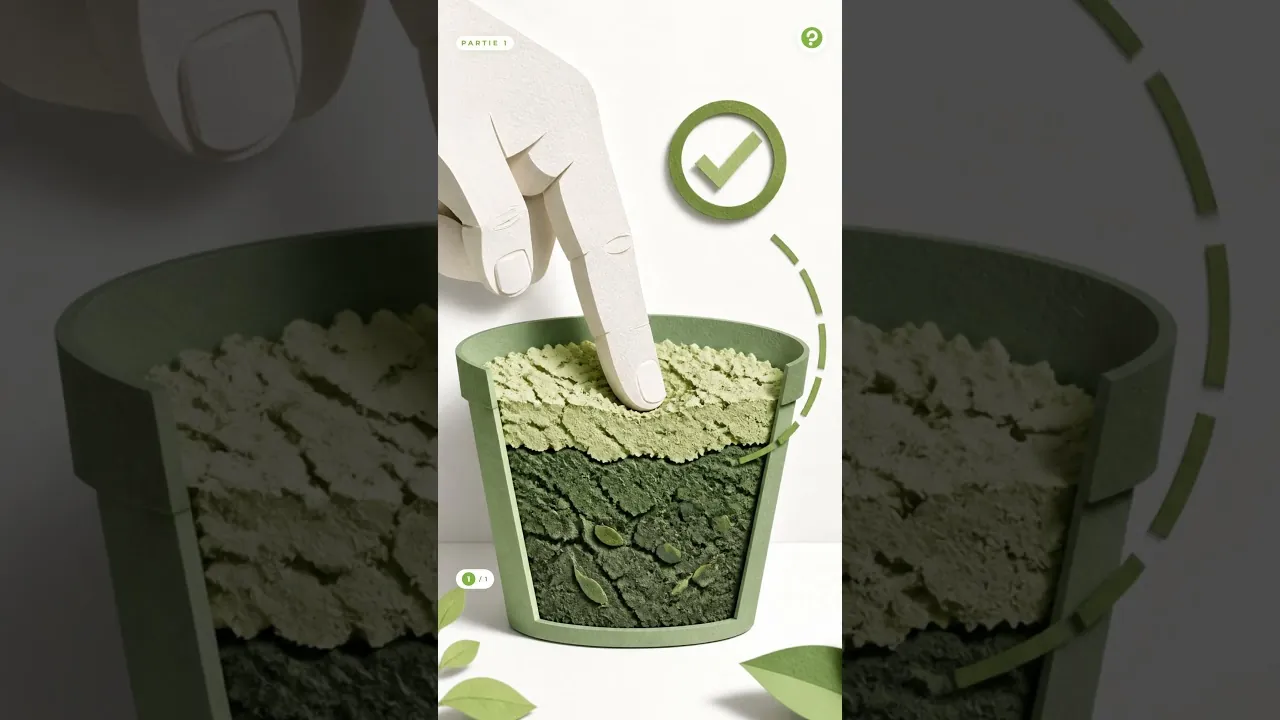
01 / 04When to water the finger test
Mistake number one: watering on a fixed schedule regardless of the season. The right method: the finger test.
1st knuckle dry = water now
Watering every Monday or every three days regardless of the season — that's mistake number one. Every plant has different needs, and those needs vary with light levels, ambient temperature, and pot size. The only reliable method: push your index finger into the soil up to the first knuckle, about two centimetres deep. If the soil is dry at that depth — water. If it's still cool or damp — wait one to two days. This test takes three seconds and replaces any pre-set watering schedule.
Summer ×2 frequency — winter ÷2
Second adjustment: season changes water needs. In summer, heat and evapotranspiration dry the soil twice as fast — you may water twice as often, but always after checking with the finger test, never blindly. In winter, most houseplants enter semi-dormancy: photosynthesis slows down and roots consume less water. A common mistake is keeping the summer watering schedule in winter — that's the second cause of overwatering. Cut the frequency in half, let the soil dry out more between waterings, and reduce the volume too.
02 / 04How to water at the base, room-temp water
Mistakes two and three: pouring cold water directly on the leaves. Two major consequences.
Water at the base — never on the leaves
Pouring water directly on the leaves is a common mistake with two effects. First consequence: water droplets on leaves act as magnifying glasses under sunlight, causing visible burns in the form of brown or discoloured spots. Second consequence: persistent moisture on the foliage is the ideal breeding ground for fungal disease — powdery mildew, botrytis, leaf spot. Always water directly into the soil, aiming at the inner edge of the pot rather than the centre, so water spreads evenly toward the roots at the perimeter.
Room-temp water — let sit 24h
Third mistake: using cold water straight from the tap. A thermal shock between water at twelve degrees and a plant in a room at twenty-two degrees can cause visible water stress — leaves turn yellow at the base within two days. Simple rule: fill your watering can the evening before and leave it at room temperature overnight. This twenty-four hour rest has two benefits: the water reaches room temperature, and chlorine evaporates — sensitive plants like orchids and ferns do noticeably better for it. If your tap water is very hard, add a few drops of white vinegar or use rainwater for acid-loving plants.
03 / 04Drainage saucer + clay pebbles
Mistakes four and five: the saucer full of standing water and the pot with no drainage hole.
Empty the saucer 30 min after watering
The saucer is there to protect your floor, not to act as a permanent reservoir. If you leave water sitting in the saucer for more than thirty minutes, the roots stay in contact with it and start to suffocate from oxygen deprivation. Within a few days, the roots rot — a condition called root rot that is irreversible in most cases. Simple rule: water, wait thirty minutes, empty the saucer. If it fills quickly, that's a sign you're pouring too much volume each time — reduce it.
Clay pebbles at the bottom = perfect drainage
To improve drainage permanently, place a three to five centimetre layer of clay pebbles — also called expanded clay aggregate — at the bottom of the pot before adding the soil. These pebbles create an air gap between the pot's base and the soil ball, letting excess water drain freely toward the drainage hole without submerging the roots. They are reusable indefinitely after rinsing. Combined with a pot that has drainage holes and a regularly emptied saucer, they make accidental overwatering much less dangerous.
04 / 04Read the signs overwatering vs underwatering
Sixth mistake: not being able to read the leaves. The symptoms of overwatering and underwatering are different — and the response is opposite.
Yellow + limp = too much water
Overwatering: leaves turn yellow starting at the base of the plant or the lower leaves, they become limp and slightly translucent, and the soil stays constantly wet. You may also notice a faint musty smell coming from the soil. What to do? Stop watering for seven to ten days. Remove the soil ball and inspect the roots: if they're brown and mushy, cut the rotten parts with clean scissors and repot in a fresh, well-draining mix. If they're still white and firm, simply stopping the watering is enough in most cases.
Brown + crispy = not enough water
Underwatering: leaves turn brown starting at the tips and edges, they become crispy and brittle to the touch, and the soil is dry and hard, sometimes pulling away from the pot sides with small cracks. The plant itself may lean more noticeably toward the light source. What to do? For very dry soil, submerge the entire pot in a basin of water for twenty minutes — the soil ball re-hydrates evenly. Then return to your normal rhythm using the finger test as your only guide, never a pre-set schedule.
This advice is general information and does not replace a professional's opinion. When in doubt (health, electricity, chemicals), ask a specialist.
Sources
Want more tips like this one?
Subscribe to the channel