You charge overnight, you let it drain to zero, you grab whatever charger is nearby. These habits seem harmless. In reality, they can cut your battery's lifespan in half in less than a year. Let's go through the four most common mistakes — and what to do instead.
01 / 04Overnight charging your phone under voltage for 8 hours straight
First enemy of your battery: charging it overnight, every single night.
8 hours at 100% = accelerated wear
Plugging in every night and unplugging every morning is what over seventy percent of people do. The problem is your battery stays locked at one hundred percent for six to eight hours under constant voltage. Lithium-ion chemistry doesn't like that. Each night, you're creating micro-stress on the cells. After two years of daily use, you can lose up to thirty percent of capacity just from this one habit alone.
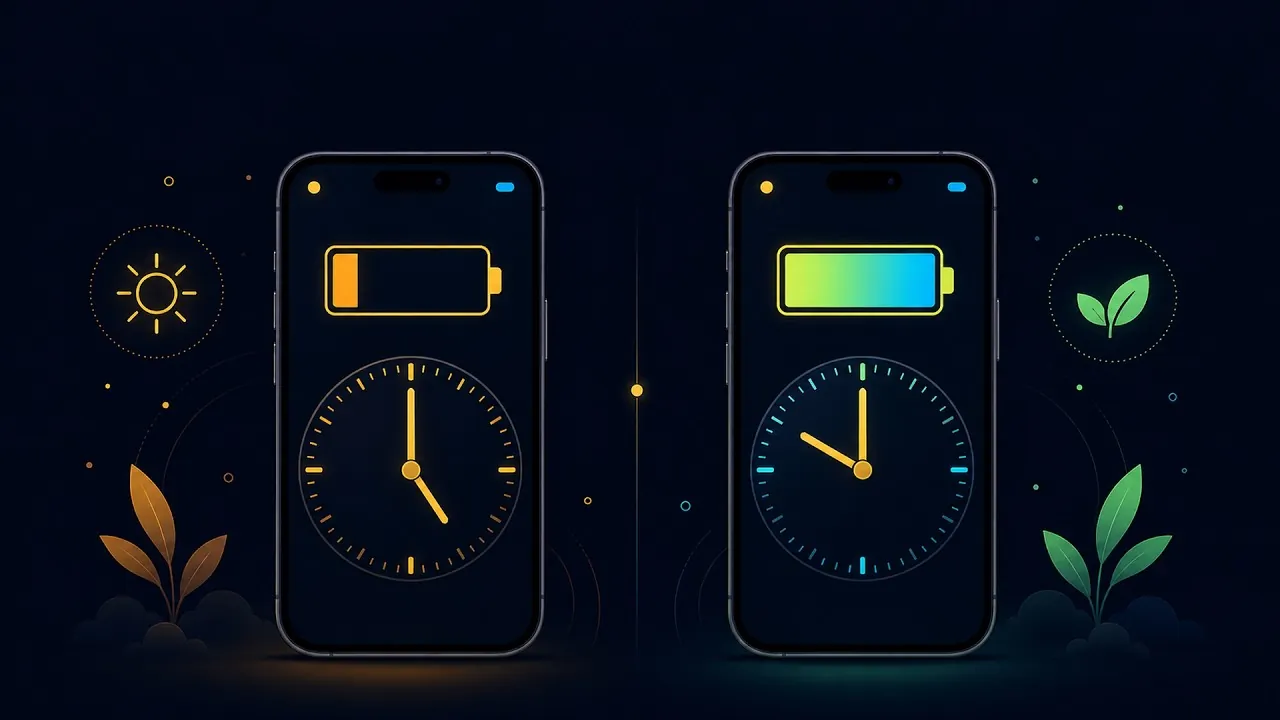
Fix: cap at 80% or start at 50%
The fix is simple. On iPhone, enable Optimized Battery Charging in Battery settings: iOS stops at eighty percent and tops up just before you wake up. On Android, Samsung and other makers usually offer a charge limit at eighty or eighty-five percent in settings. And if you still want to plug in overnight? Start at around fifty percent. Your phone will reach eighty percent by midnight and won't keep heating up unnecessarily.
02 / 04Draining to 0% the myth from old nickel batteries
Second classic mistake: letting your phone die to zero to recalibrate the battery.
Below 20%: irreversible crystallization
Draining your phone to zero to recalibrate it is a myth from the nineteen-nineties, when nickel-cadmium batteries had memory effect. Lithium batteries work differently. Below twenty percent, lithium ions irreversibly crystallize on the anode. One full discharge to zero is roughly equivalent to several days of normal charging in terms of wear. It's direct chemical stress on the cells.
Sweet spot: 20% → 80%
The golden rule from Apple and Google engineers: keep your battery between twenty and eighty percent. They call this the electrochemical sweet spot. In this range, charge and discharge cycles stress the cells far less. In practice: plug in when you drop below twenty percent, and unplug before or when you hit eighty. This single habit alone can easily double the number of useful charge cycles in your battery.
03 / 04The uncertified charger unstable current = silent degradation
Third mistake: using whatever charger you find, with no certification.
Unstable current = voltage spikes = wear
An uncertified charger at two or three euros sends unstable current with voltage spikes. Each spike stresses the lithium cells. Short term, you notice nothing — but after six months, your battery has lost ten to fifteen percent more capacity than with a certified charger. Warning signs: your phone heats up abnormally while charging, or the battery drains faster than before. In extreme cases, voltage surges can even damage the motherboard.
What to look for: USB-IF, MFi, manufacturer brand
What to look for on a cable or charger: the USB-IF logo on USB-C cables, MFi certification for iPhones, or simply your phone maker's own brand. These certifications guarantee regulated current and surge protection. A new certified charger costs between fifteen and thirty euros. That's far less than replacing a battery — fifty to a hundred euros at a service center — or a new phone.
04 / 04Heat exposure the silent enemy of every battery
Fourth enemy, often underestimated: heat.
Above 40°C: degradation ×3
Sun exposure, a parked car in summer, the beach — your phone can reach forty-five to fifty-five degrees Celsius in these conditions. Above forty degrees, internal chemical reactions accelerate. The battery degrades up to three times faster than normal. In practice: never leave your phone in direct sunlight, even through a window, even for just a few minutes. Cars reach seventy degrees Celsius inside in summer.
Remove your case during fast charging
Another hidden enemy: charging your phone inside a thick case. Charging generates heat. A silicone or leather case traps that heat around the device. Result: your phone charges at thirty-eight to forty-two degrees instead of thirty. If you charge frequently, especially with fast charging above fifteen watts, remove the case while charging. It's a simple gesture that significantly reduces heat buildup.
Recap: 4 rules = battery ×2
To recap the four rules: keep your battery between twenty and eighty percent, don't charge overnight, use a certified charger, and avoid heat. These four habits applied together can easily double your battery's lifespan. On a seven-hundred-euro phone, that's hundreds of euros saved — and a battery that still holds strong when you eventually sell your phone.
This advice is general information and does not replace a professional's opinion. When in doubt (health, electricity, chemicals), ask a specialist.
Sources
Want more tips like this one?
Subscribe to the channel